Why Breaking Your Diet with Nicci Robertson is the Healthiest Decision You’ll Ever Make

Nicci Roberton discovered through trial and error that true wellness begins when you stop following the rules and start listening to your body.
Nicci Robertson is breaking the rules — and your diet!
Nicci discovered through trial and error that true wellness begins when you stop following the rules and start listening to your body. Today, Nicci is a nutritionist, author, and wellness coach who advocates for real health from lived experience. Her philosophy is rooted in science, but begins with understanding your body’s unique needs.
Nicci’s Shift from Diet Desperation to Health Dedication
Anybody who reads your biography on your website will appreciate how you reinvented yourself. What was the aha moment when you knew ‘this is what I must change’ and ‘this is what I can teach’?
I was literally all out of options after dieting for most of my life. I’d tried everything, and nothing worked in the long term. Whatever weight I lost only came off using extreme measures, and then it came back with interest.
I remember lying in bed one night in physical and mental pain and clearly making a “deal” with God. I promised to spend the rest of my life helping people to get healthy if I was shown the path to getting my own health in order. The next day I simply got up and started implementing. The answers were always there; I just never believed they would work.
What was your biggest challenge that you had to overcome to achieve your goals?
For a long time, I thought that we are all overruled by our genetics. Carbon copies of our parents rather than our patterns of behaviour. Then one day, someone said that what I was trying to achieve was impossible. That I may as well make peace with who I was. Someone who clearly had their own self-esteem issues and also believed that change was futile. That statement was like a red flag to a bull. It was exactly what I needed to hear. My biggest motivator is when people say that something is impossible. Whether it’s losing weight, publishing a book or creating a TV show, I’ll go the ends of the earth to find a way and do it well.
Challenging Diet Culture: Why We Must Break the Rules
Why challenge conventional diet culture and “break the diet rules”?
Because typical diets don’t work in the long term. They are unpleasant, unsustainable and teach the body to store fat rather than use it for energy. The energy deficit model – or the lazy darling of diet culture sounds so tidy. Burn more than you eat, and you’ll lose weight. In reality, it’s about as useful as saying, “Just spend less than you earn, and you’ll be rich.” True, but hopelessly oversimplified.
When you cut calories, you initially lose weight, but soon your metabolism slows down to conserve energy; it’s a survival response. Hormones like leptin, ghrelin, and cortisol shift, amplifying hunger and cravings while suppressing mood and energy levels. So while the calculations might work in theory, your biology rewrites the equation in real time.
Navigating ‘Body Positivity’ Versus Optimum Health
How do you navigate that delicate balance between ‘body positivity’ versus ‘optimum health’?
In my case, “body positivity” was born largely from feeling hopeless, and I figured that accepting myself as things were was the best option at the time, given the fact that I couldn’t find a solution. The problem is that this mindset more often than not results in dire health consequences. Glorifying obesity or pretending that carrying excessive fat has no consequences isn’t empowerment; it’s denial. Using body positivity to justify poor nutrition, inactivity, or lifestyle habits that increase disease risk actually betrays the core idea, which is about freedom from shame, not freedom from responsibility. Once I’d accepted that the situation couldn’t continue and found a strategy that worked, body positivity was more about acknowledging progress and doing the best with what I had at the time. This is something I work on building with my clients constantly.
Is change different for everyone, or are there some common denominators?
As a species, we aren’t motivated to change without a state of discomfort. The comfort zone has to become drastically uncomfortable for anything to shift – I think this is universal. For some people, that means having a heart attack before taking action. While for others, they need less of a nudge. I suppose it depends on what motivates you. – the reward or punishment.
Your clients are high-performing athletes and executives. How are their challenges different?
Athletes come to me with specific performance goals in mind, and so do execs and entrepreneurs. At this level, people understand that if they want to be more effective and win in life they need a system that is tailored to their outcomes, and they fully commit to sticking to the system.
Driving this is the belief that anything can be achieved with the right formula. I think that this is the fundamental difference between people who are high achievers and everybody else. Self-belief and working towards to goal which expands beyond yourself is really the key to achieving anything, both personally and professionally.
Their challenges are only different in that their careers often depend on mind and body mastery.
The Hormonal Equation: Why Calories Don’t Matter
Why don’t calories matter in the way we’ve been led to believe?
If healthy fat loss were simply about cutting calories, then there wouldn’t be a diet industry. Simply eat less for a couple of days, and your problems would go away.
Humans digest, absorb, ferment, excrete, and convert food with wildly different efficiency. Two people can eat the exact same meal and get totally different usable energy from it.
Hormones dictate whether calories get burned or hoarded like a squirrel preparing for winter. Calories do not dictate fat storage; your hormones do.
100 calories of tuna does not behave like 100 calories of doughnuts. Tuna says, “Let’s build muscle and balance blood sugar”. While the doughnut says, ”Trigger an insulin deluge and store fat.” Same calories, different metabolic message.
What are some of the biggest myths around “healthy eating”?
There are so many! One of the most persistent nutritional fads is the blood group diet, which has been disproven numerous times. Its’ one-size-fits-all simplicity is appealing to lazy practitioners. But your genetics, gut microbiome, hormones, and lifestyle all play a much bigger role than your blood group ever will.
Another is that “Carbs are the Enemy”. Carbs aren’t the problem; ultra-processed, refined starches and sugars are. Possibly the biggest lie is that “If it’s plant-based, it’s healthy.” There’s a huge difference between eating lentils, beans, and vegetables and eating plant-based products. Many of these products are ultra-processed food mimics full of stabilisers, gums, seed oils, and salt. If your “plant-based burger” has 22 ingredients and half of them are unpronounceable, that’s not healthy food
Social media is flooded with diets – from vegan to carnivore – how do you personalise a meal plan?
I start with an extensive questionnaire and health history. I want to know all about your current relationship with eating, thought processes, exercise habits and sleep patterns. This is followed by blood tests to really get a sense of what is happening in the moment. What people say and what shows up in their blood can be very revealing. Based on this information, I create a plan that we can test for a couple of weeks. What I’m looking for is improved energy, improved mood, better hunger regulation and of course fat loss if that is the objective. Sometimes the objective is gut health, lowering cholesterol or blood sugar or managing pain. The plan is re-assessed often and modified until it’s right. You should never feel restricted or that you are dieting.
One of your specialities is Gender Specific Nutrition. If the sexes are equal, can diets be different?
Women and men have fundamentally different physiologies, which affects how they respond to nutrition, exercise, stress, and recovery. Estrogen and progesterone fluctuate throughout the menstrual cycle. These hormones change how women use fuel, recover from exercise, regulate body temperature, and maintain hydration. Most exercise and nutrition science is based on men or post-menopausal women. This means much of the existing guidance for training, nutrition, and recovery does not account for the complexities of female physiology. Many women know too well that the “Banting Diet” or Intermittent fasting plan that worked for their male partner did nothing for them.
The only similarity across gender and age is to avoid processed foods and try to consume as much real food as possible. When, what and how much will vary.
How can people build a healthier, more sustainable relationship with food?
For many people, it begins with unlearning what they were taught about food. For many people, early on in life, food became associated with a range of emotions that failed them later on. Building a healthier relationship with food often begins with building a healthier, less judgmental relationship with yourself. The moment food becomes “good” or “bad”, you trigger shame. Shame leads to bingeing, restriction, then more shame. The same can be said for the need to overcomplicate. Build meals around protein, add colourful plants, keep healthy fats in the mix, and suddenly the typical drivers of hunger and cravings change. Cooking puts you back in the driver’s seat. You get to choose quality, portion, flavour, and your kitchen becomes your empowerment zone.
I love your recipes because I’m convinced most people don’t eat well because they can’t cook, but you teach people how easy it is to make healthy food exciting. What gets you excited about cooking?
I grew up around people who were obsessed with food and cooking. My father’s family owned several bakeries and delicatessens. While my mother’s family were Parisian, importers of luxury French foods. I was very fortunate to travel extensively with my parents and get exposure to a wide variety of cuisines from a very young age. At home, eating was always a production and a massive source of stress in my mother’s life. To say she had a love-hate relationship with eating was an understatement. Being a ballet dancer who grew up in the Twiggy era, she was constantly dieting, while my father associated food with love and nurturing. You can only imagine the discourse this created.
I learned a lot about developing recipes based on a couple of simple rules that underly everything when it comes to creating anything worth sinking your teeth into. My first book, Thrive, is a collection of recipes that I created for my clients to make sure that they never felt like they were on a diet while getting healthy and losing weight at the same time. The idea was to make healthy food taste like something that would satisfy any craving, fill you up and enhance your health. Mind Body and Soul Food is mostly a collection of recipes we ate often growing up. Ive adapted most of them to contain less sugar and where possible, more protein. What really gets me excited is creating a recipe from scratch or getting inspiration from something Iv’e come across and then making it just a little better. The true test comes from the reaction I get when people make it themselves and it works out perfectly every time.
Grocery Shopping: Where Real Food Lives in the Supermarket
Healthy eating begins in the supermarket. What are your tips when grocery shopping?
Keep your shopping to the perimeter of the store. This is where real food lives. The middle aisles are where long-life, shelf-stable foods live. While shelf-stable foods aren’t all bad, you want to stay away from ready-made foods as much as possible so that you can control the ingredients. Always shop with a plan and use tools like Woollies Dash or Checkers 60/60 to keep you on track and away from temptation. Try to make a habit of choosing quality over quantity. If you are going to dive into temptation, do it properly – a great chocolate makes you savour instead of devour.
Most importantly, buy local and whatever is in season. Don’t avoid frozen fruit and veggies – less food waste and less expensive.
Is the South African food culture healthy, and how can we make it healthier?
South African food culture is a mixed bag. On one hand, we have an incredibly rich culinary heritage, vibrant flavours, and some naturally nutritious and inexpensive staples. On the other hand, modernisation, urbanisation, and convenience foods have created a nutrition paradox. Reclaiming traditional food culture, in my opinion, is a great way to improve health without breaking the bank. Swap refined maize meal for less processed variants. Use beans and lentils in stews to increase fibre. Stews, curries, chakalaka, and braai’s are already nutritious; just be mindful of added salt, sugar, and refined seed oils.
Where possible, grow your own – even if all you have space for is herbs on a windowsill, that counts!
What ingredients do you always have on hand?
Good quality olive oil, garlic, onions, farm eggs, plain yoghurt and a wide variety of herbs and spices. After this I always have a premium quality whey protein powder available to fill in the protein gaps. Fresh produce and animal protein is variable – whatever is in season. This is the basis for almost everything in my opinion.
What’s your go-to meal that you can throw together within thirty minutes?
VooDoo Potatoes and Slow-cooked Lamb are so easy to make and a hit with everyone.
Nicci Robertson’s Voodoo Potatoes
Serves: 6 Prep time: 5 minutes
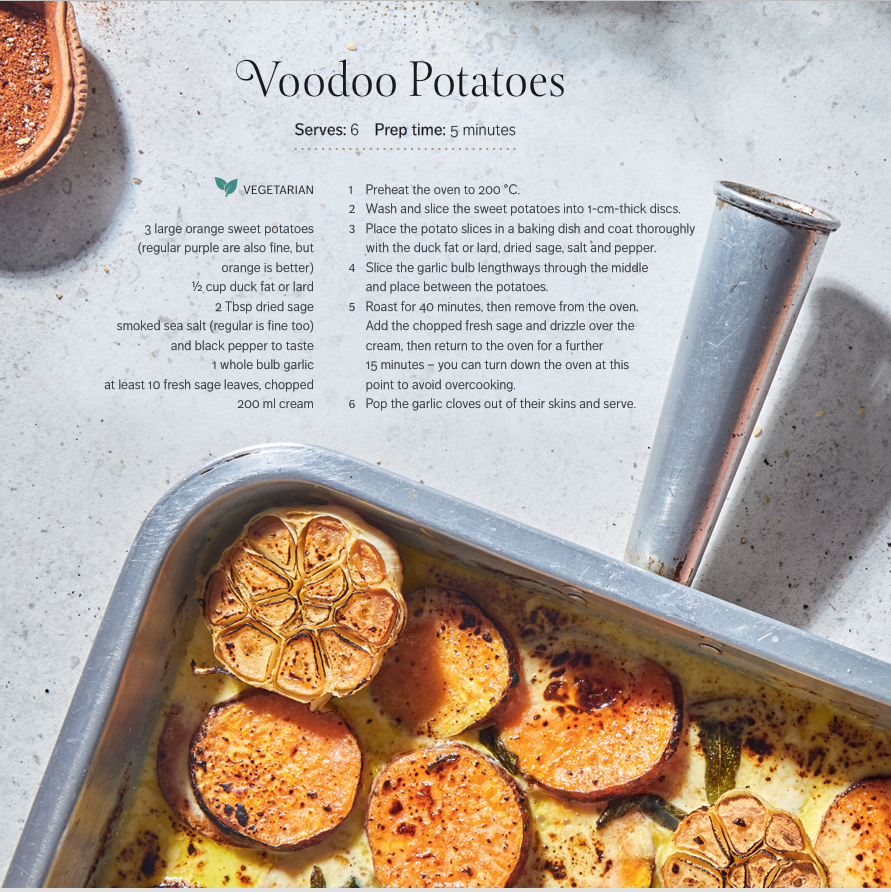
VEGETARIAN
3 large orange sweet potatoes
(regular purple are also fine, but
orange is better)
1⁄2 cup duck fat or lard
2 Tbsp dried sage
smoked sea salt (regular is fine too)
and black pepper to taste
1 whole bulb garlic
at least 10 fresh sage leaves, chopped
200 ml cream
1 Preheat the oven to 200 °C.
2 Wash and slice the sweet potatoes into 1-cm-thick discs.
3 Place the potato slices in a baking dish and coat thoroughly
with the duck fat or lard, dried sage, salt and pepper.
4 Slice the garlic bulb lengthways through the middle
and place between the potatoes.
5 Roast for 40 minutes, then remove from the oven.
Add the chopped fresh sage and drizzle over the
cream, then return to the oven for a further
15 minutes – you can turn down the oven at this
point to avoid overcooking.
6 Pop the garlic cloves out of their skins and serve.
Nicci Robertson’s Slow-cooked Lamb
Serves: 6 Prep time: 30 minutes

3 cloves garlic, chopped
1 tsp chopped ginger
1 tsp chopped turmeric
1 tsp ground cinnamon
1 tsp ground cumin
1 tsp ground coriander
2 tsp sea salt
1 tsp cracked black pepper
6 cardamom pods, cracked open
100 ml olive oil
50 ml lemon juice
2 tsp lemon zest
2 kg leg of lamb, bone in
2 red onions, finely sliced
2 cups chicken or vegetable stock
12 baby potatoes
1 white onion, roughly chopped
4 bunches bok choy or
200 g baby spinach
1 Tbsp salted butter
1 Tbsp olive oil
fresh rosemary to garnish
This recipe is simple but time-consuming, as ideally you prepare
the lamb the day before cooking. It’s worth the effort, though!
1 In a bowl, combine the garlic, ginger, turmeric, cinnamon,
cumin, coriander, salt, pepper and cardamom pods.
2 Add the olive oil, lemon juice and lemon zest, and mix well.
3 Thoroughly coat the lamb in the marinade and red onion
slices and leave in the fridge overnight. Remember to take
the lamb out of the fridge an hour before cooking.
4 Place the lamb in a slow-cooker on high and add the
chicken or vegetable stock. Leave to cook for 4 hours.
5 Just before the time is up, preheat the oven to 180 °C.
6 Slice the baby potatoes in half, leaving the skin on, and roll
in sea salt.
7 Place the lamb, potatoes and white onion in a cast-iron or
any ovenproof dish with a lid and roast, covered, for 1 hour or
until the potatoes are soft and the lamb shreds easily.
8 Remove from the oven and leave to rest for 15 minutes.
9 Just before serving, steam the bok choy or baby spinach in a
little water until just wilted, drain and mix in the tablespoons
of salted butter and olive oil.
10 Serve immediately, garnished with fresh rosemary.
High-Performance Clients and Corporate Wellness
How has Corporate Wellness evolved from your perspective?
I can’t say that corporate wellness has really evolved. Companies have become more reliant on wellness days and rewards programs than actually digging into addressing what drives healthy behaviour in the first place. At a time when we need human connection most, companies have adopted AI and health bots in the name of scalability, when what is needed most is access to a real person. Neurochemically, we need human connection to foster accountability and heal.
When I started off in corporate wellness almost 20 years ago, I worked with vast groups of people. The energy was magnetic and everyone supported and encouraged each other to do better. What we did filtered into communities and changed the lives of people who weren’t even directly involved.
Nowadays, there’s “an app for that”, which we’ve come to realise doesn’t have the same impact.
One small daily habit that can impact long-term health of the individual and the planet?
Practice mindful consumption. Whether it’s buying clothes, food, or gadgets, pause and ask yourself if you actually need this. Every single thing we buy, eat, wear, or scroll through has an invisible cost. There’s the financial price tag, but also the energy, resources, and labour that went into making it. Practising mindful consumption means you stop moving through life on autopilot and start asking yourself if this adds real value to my health, my happiness, or the world. Most people think of mindful consumption as buying less, but it’s also about buying better.
You’re quite a high-performer yourself – nutritionist, author, speaker, coach, creator, podcaster, producer, and presenter – what advice do you have to remind yourself of to keep it all together?
Many years ago, I attended a functional medicine conference. The speaker, Dr Jeff Bland opened the talk with a question: “How big is your classroom?” He said that it was the responsibility of each and every one of us to make a difference in the world. That really resonated. I can’t say that I remembered anything else from that talk. Having worked for several multinationals, I felt firsthand the impact that the right message could have and how, if done with the right intention, it could change lives for the better. This is the driver behind everything and the reason I have the energy to do what I do every day.
Finally, what is your one guilty pleasure that you will never admit to anyone?
I never feel guilty about pleasure, and I will never say no to a great gelato.
Images courtesy of Nicci Robertson | www.reinventhealth.co.za